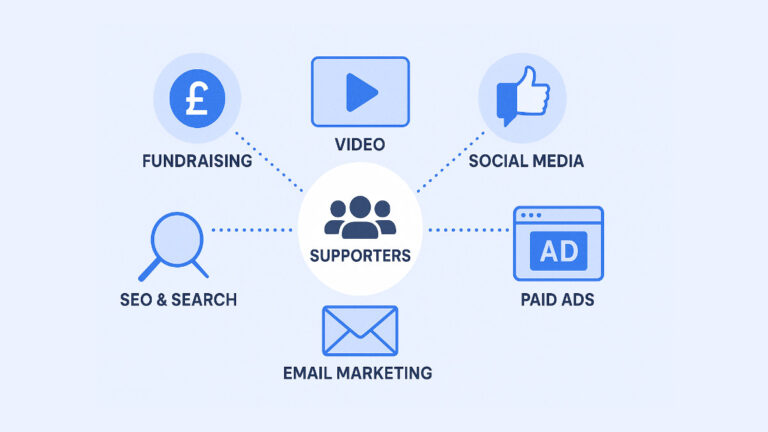



A charity can do excellent work and still struggle to raise money because too few people know it exists and the ones who do are unsure they can trust it with a donation. That is a branding problem, though it rarely gets called one. Branding is how people find you, recognise you, and decide you are worth supporting. Get it right, and the cause reaches the people who care about it. Get it wrong and good work goes unseen.
I am writing this guide about charity branding in that practical sense – not logos and colour palettes for their own sake, but the visibility and trust that decide whether your charity grows or quietly fades. It is written for trustees and CEOs who suspect branding matters but have treated it as a luxury they will get to later. The argument here is that it is closer to a foundation than a luxury, and that building it well is within reach of a small organisation without a marketing budget.
If you want help developing a brand that reflects your mission, you can book a call.
What is charity branding, really?
Your brand is not your logo. It is the impression people carry about your charity – what they think you do, who they think you help, and how much they trust you to do it well. The logo is one small signal of that impression. So are your website, your tone of voice, the way you answer an email, and the story a supporter tells a friend about you. Branding is the work of making that impression clear, consistent and true.
For a charity, the impression carries more weight than it does for a business, because you are asking people to give you money and trust you to use it well, with no product in return. A donor is buying confidence that their gift will do what you say it will. Everything in your brand either builds that confidence or chips away at it.
Why does branding matter for a small charity?
Because visibility and trust are the two things standing between your mission and the people who would support it, and branding is how you build both. Three things follow from getting it right.
- People can find you. A clear, recognisable brand makes it easy for a potential donor, volunteer or funder to understand who you are and what you do in seconds. When they cannot, they move on to a charity they can understand.
- People decide to trust you. A consistent, honest brand signals that the organisation behind it is well run. Funders reading your website form a view of your competence before they read a word of your application.
- Support compounds. Recognition builds over time. A charity people recognise and trust finds each year of fundraising a little easier than the last, because the goodwill carries forward.
None of this requires a large budget. It requires clarity about who you are, and the discipline to show up the same way everywhere. A small charity that does this well can stand out more than a larger one that does it carelessly. Branding sits alongside the other foundations of a charity that lasts, which is why it belongs in a conversation about building your charity, not just your marketing.
The foundations: mission, values and audience
A brand that lasts starts with clarity about the charity underneath it, so three things come before any design decision.
1) Your mission and values
Say, in plain words, what change you exist to create and the principles that guide how you work. If you cannot state your mission in a sentence a stranger would understand, no amount of design will fix the confusion – the clarity has to come first. Your values then structure the tone of everything that follows.
2) Your audience
Know who you are speaking to before you decide how to speak. A charity serves several audiences – donors, beneficiaries, funders, volunteers – but one usually leads, and understanding what matters to them influences your message. Guessing at this is where a lot of charity communication goes wrong: it is written for everyone and lands with no one.
Building your brand identity
Once the foundations are clear, your brand identity is how they show up in the world. It has three parts, and consistency across them is what makes a brand recognisable.
1) Visual identity
Your logo, colours and typography should reflect your charity’s character and stay the same wherever they appear. The point is not artistic merit. It is recognition: people should know it is you at a glance. Choose colours and a style that suit your mission and that you can apply consistently across a website, a leaflet and a social post.
2) Brand voice
How you sound matters as much as how you look. Decide on a tone – warm, plain, hopeful, direct, whatever fits your charity – and hold to it across every channel. A consistent voice makes the organisation feel like one coherent thing rather than several people writing past each other.
3) Your story
People connect with a clear story about why you exist and the change you make. A good brand story explains the problem you address, the difference you make, and the part supporters play in it. Told honestly, it does more to build connection than any list of statistics.
Consistency across every touchpoint
A brand is built by repetition. Every place someone meets your charity – website, social media, printed materials, emails, the way a volunteer answers a question – should feel like the same organisation. When your website says one thing and your leaflet says another, supporters notice the gap, and the inconsistency quietly erodes trust.
Simple brand guidelines help here: a short document setting out your logo use, colours, fonts and tone, so that anyone creating something for the charity stays aligned. It does not need to be elaborate. It needs to exist and be used. In a small charity where several people and volunteers produce content, this one document prevents a lot of drift.
Your website and digital presence
Your website is where most people form their first real impression, so it carries a large share of your brand. It should make five things clear within seconds: who you are, why you exist, who you help, how funds are used, and how to get involved. When people understand you quickly, trust builds on its own.
The build itself – platform, accessibility, structure – is a subject of its own, and we cover it separately in our guidance on charity website design. For branding, the point is narrower: whatever you build should carry your identity consistently, work on a phone, and make the path to donating or getting involved obvious.
Storytelling with dignity and consent
Stories are the heart of charity branding, and they carry a responsibility most branding advice skips over. The people in your stories are often beneficiaries in vulnerable situations, and their dignity comes before the appeal. Always gain informed consent before sharing someone’s story or image, be honest about what you are asking and where it will appear, and give people a genuine choice to decline without any loss of the support they receive from you.
Told with care, real stories of change connect supporters to the cause more deeply than any campaign slogan. Told carelessly, they can exploit the very people the charity exists to serve, and the reputational damage from that is hard to undo. The discipline is simple: consent first, dignity always, and never a story that the person in it would be uncomfortable seeing.
Bringing your team into the brand
A brand only holds if the people delivering it understand it. Staff and volunteers represent the charity in every interaction, so a short session on what the brand stands for, and how to speak and write as the charity, pays off quickly. When the team shares an understanding of the brand, consistency stops being something you police and becomes something that happens naturally.
Measuring whether your branding works
You do not need elaborate analytics to know whether your brand is landing. A few honest measures a small charity can actually track will tell you most of what you need.
- Recognition and reach. Website visits, social media engagement, and whether people are starting to mention or find you without prompting.
- Engagement and conversion. Donations, sign-ups, enquiries and event participation – the actions that show recognition turning into support.
- Perception. What supporters and beneficiaries actually say about you. A handful of honest conversations often tells you more than a dashboard.
A regular brand review – looking at whether your website, materials and messaging still say the same thing and still fit the charity – keeps the brand aligned as the organisation changes. Once a year is usually enough for a small charity.
Partnerships and sustainability
Working with the right partners can extend your reach and lend credibility. A well-matched partnership with another charity, a local business or a corporate sponsor puts your brand in front of new audiences, provided the partner’s values genuinely fit yours – a mismatched partnership does more harm than good. Keep any collaboration clear on shared goals and how each brand is represented.
It is also worth being honest, in your branding, about how the charity operates – transparency about impact and about how money is used is itself part of the brand, and increasingly part of what supporters look for. You do not need a grand sustainability programme to say plainly what you do and how you do it. That honesty builds more trust than any claim.
Where to start with your charity branding
Branding is not a one-off project that finishes. It grows as the charity grows, and it works through consistency held over time rather than through a single launch. The charities that build strong brands are the ones that got clear about who they are, showed up the same way everywhere, and kept at it long enough for recognition to build.
So start with clarity. Write down, in one sentence each, who you help, what change you make, and why someone should trust you with a donation. Check that your website and materials actually say those three things plainly. Fix the biggest gap first. If you would like help building a brand and a wider marketing and fundraising approach that reflects your mission, a conversation is a good place to begin, and there is more practical guidance in our articles and guides.