


Scroll through the social media of ten small charities, and a pattern appears. Clean graphics. A donation ask. A stock photograph with a quote laid over it. Everything looks competent, and almost none of it sounds like anyone in particular. The accounts are active, the branding is consistent, and a supporter scrolling past feels nothing and keeps scrolling.
That gap between looking professional and feeling real is where a lot of charity social media quietly loses people. Supporters give to organisations they believe in, and belief comes from seeing the people who do the work and hearing what they sound like. This article is about closing that gap: why polished content often fails to build trust, what happens when the charity’s own voice goes missing, and how a small team can bring it back without a bigger budget.
If you want help planning social media that reflects your charity, you can book a call.
Why does polished social media fail to build trust?
Because people recognise advertising and treat it accordingly. A feed of branded graphics and donation asks reads as a campaign rather than an organisation, and campaigns get scrolled past. Supporters have spent years learning to filter out anything that looks like it came from a marketing department, and a charity account that looks like every other marketing account gets filtered out with the rest.
The content that holds attention tends to be less tidy. A volunteer talking to a phone camera at the end of a shift. A short clip of a delivery arriving. A trustee explaining what a grant will pay for, with the room visible behind them. These carry something a designed graphic cannot: evidence that the charity is made of people who are actually doing the work. Video does this more directly than any other format, which is why even a rough thirty-second clip usually outperforms a thoroughly produced still image.
Polish has its place. A charity that looks chaotic online raises different doubts. The point is narrower: polish reassures people that you are organised, and voice persuades them that you are real. Accounts that carry only the first tend to plateau.
What outsourcing gets right, and where it falls short
Many small charities hand social media to an agency or a freelancer, and there are sound reasons for it. A team of four with no design skills and no spare hours gets consistency, a posting schedule that holds, competent graphics, and someone who understands paid advertising. That is worth having, and a charity posting nothing at all is in a worse position than one posting agency content.
The difficulty comes when the voice gets handed over alongside the scheduling. An agency can produce a campaign, but it cannot supply your staff, your volunteers, or the texture of a Tuesday afternoon at your project. Working from a brief and a brand guide, it produces what the brief allows: branded posts and donation asks. Staff and volunteers rarely appear, beneficiaries almost never, and the account gradually becomes a description of the charity written by someone standing outside it.
The arrangement that works keeps the division clear. The agency handles the things a stretched team genuinely cannot – design, scheduling, ads, analytics – and the charity supplies the raw material only it has. If your agency is producing everything from scratch with no input from the people doing the work, that is the gap to close, whether or not you keep the agency.
What your social media signals about your charity
Social media has stopped being only a marketing channel for charities. A funder doing background checks looks you up. So does a prospective trustee, a parent deciding whether to bring their child to your service, and a local business considering a partnership. What they find forms a view of how the organisation is run before anyone speaks to you.
An account that posts regularly, shows real activity, answers questions and explains where money goes reads as an organisation in good order. Silence, or a feed of donation asks with no visible work behind them, raises the opposite question. Transparency about what supporters’ money achieves belongs in the mix for that reason, alongside the fundraising posts.
There are rules attached to this too. Your social media accounts count as online content under the Code of Fundraising Practice, which sets standards for fundraising communications and requires that your contact details and information about how you handle personal data are easy to find. Impact claims made in a post need to be accurate and capable of being substantiated, the same as anywhere else.
How to bring your own voice back in
None of what follows needs a larger budget. It needs a small amount of structure and a decision that the people inside the charity are the ones who should be visible.
1) Ask for raw material, not finished content
Staff and volunteers will not write posts. They will send a photo and two sentences if you make it easy and tell them exactly what you want. Set up one place for it to arrive – a shared folder, a group chat – and ask for something specific rather than for content in general. “A picture of the van being loaded and one line about where it is going” gets a response. “Send us your stories” does not.
2) Use short video
Thirty to sixty seconds, filmed on a phone, is enough. One person, one point, no script. The imperfection is doing useful work here, because it signals that nobody staged it. A charity that posts one honest clip a fortnight builds more familiarity than one posting three polished graphics a week.
3) Balance what you post
An account that only asks for money trains people to skip it. Mix the fundraising with posts that show the work happening and posts that talk to supporters. A useful check is to look back over your last twenty posts and count how many were asks. If the answer is most of them, that alone explains a good deal about your engagement.
4) Work with the people who already speak for you
Local advocates, long-standing supporters, a councillor who knows your work, a small local account with a following in your area – these carry more weight in a community than a national influencer would, and they usually help for nothing when asked properly. One person sharing your post to an audience that trusts them reaches further than a paid campaign of similar size.
5) Use small paid support where it earns its place
Organic reach on most platforms is limited, and a modest, targeted budget behind your strongest piece of content extends it. Put money behind something that is already working rather than behind a generic appeal, and keep the amounts small enough that you can stop if the results do not justify it.
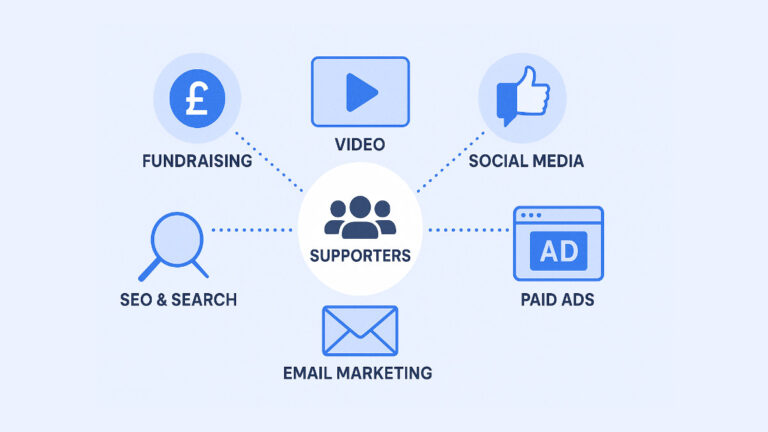
How this fits into a wider plan – formats, calendars, and how the channels work together – is covered in our guide to content strategy for charities, and the broader picture sits in our digital marketing guidance.
Consent and dignity when featuring people
Putting real people on your social media brings a responsibility that sits above the content plan, and it applies to beneficiaries in particular. Anyone appearing in a photograph, a video or a story needs to have given informed consent first; meaning they understood what would be shared, where it would appear, and that it may stay online and be seen by people they know.
Three things make that consent real. People must be able to decline without any effect whatsoever on the support they receive from you, and they need to hear that plainly. Consent should be recorded, and it should be possible to withdraw it later. And someone in a difficult situation should never be asked in a way that makes refusal awkward, which usually means asking at a distance from the moment of need rather than in it.
Where children or adults at risk are involved, this belongs inside your safeguarding policy rather than alongside it, and the Charity Commission’s safeguarding guidance for trustees sets out the wider duty. Handle images and personal details in line with your data protection obligations under the ICO as well. A story told carelessly can expose the person in it to harm, and no amount of engagement is worth that.
A useful test before publishing anything featuring a beneficiary: would this person be comfortable if their neighbour, their employer or their family saw it? If you are unsure, ask them. If you cannot ask them, do not publish it.
Where to start in the next month
Three small moves will tell you more than a strategy document, and each one takes under an hour.
Within the next 30 days
- Get one person on camera. Ask a staff member or volunteer for a thirty-second phone video about something they did this week. Post it as it is.
- Post one thing that does not ask for money. Show the work, or explain what a recent donation actually paid for.
- Name one local advocate. Identify a supporter with a following in your community and ask them to share one post.
Start with whichever feels most manageable. Consistency over a few months does more here than any single campaign, and the first honest video is usually the hardest one to publish.
Making social media worth the time it takes
Social media earns its place when it shows people who you are and gives them a reason to stay connected. That comes from the charity’s own voice – staff, volunteers, supporters and, with their consent, the people you exist to serve – rather than from the quality of the graphics around it. A small charity has an advantage here, since closeness to the work is exactly what larger organisations struggle to convey.
Pick one of the three steps above and do it this week. If you would like help building a social media approach that fits your capacity, or a wider marketing and fundraising plan, a conversation is a reasonable place to start. There is more practical guidance across our articles and guides, including how this connects to your charity branding.