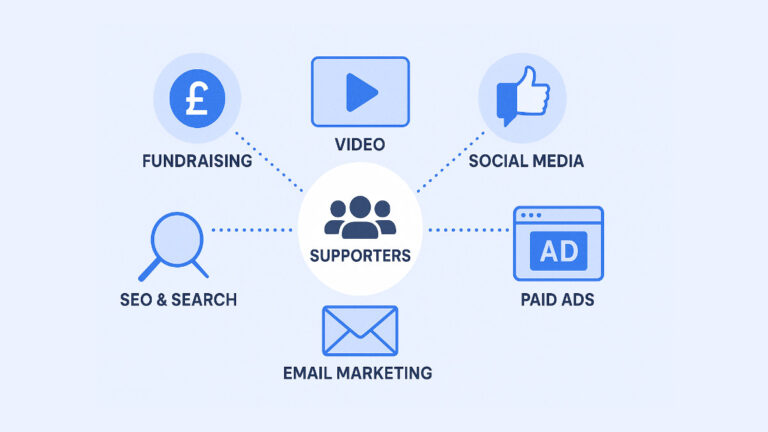



A content strategy decides what your charity publishes, why, and how often – and for a small charity, the honest version of that decision is usually to publish less than you think, and keep going.
Most small charity content does not fail because it was badly written. It fails because it was never survivable. Someone commits to weekly posting, manages six weeks, then stops. And a feed that went quiet eighteen months ago says something worse to a funder looking you up than a page with twelve posts that were all worth reading.
If your communications have stalled and you are not sure why, you can book a free clarity call.
What is your content actually for?
Content does three different jobs for a small charity, and they need different things from you.
Being findable. A funder, a donor, a prospective trustee or a referral partner searches your name and looks at what comes back. This is the job most small charities need done and least often think about. It rewards a handful of pages that stay accurate – what you do, who for, where, and recent evidence that you are active – rather than frequent posting.
Keeping the supporters you have. People who already gave, volunteered or attended need a reason to stay connected. This rewards consistency over reach, and it usually means email rather than social, because you own the list.
Building credibility before an ask. A grant application, a corporate approach, a campaign. Here content works backwards from a date: what does this funder need to believe about us, and what can we publish in the three months beforehand that makes it believable?
Charities that have not picked one produce a bit of everything. The blog gets a post when someone has time, the social accounts get whatever photos or videos exist, the newsletter goes out when there is news. It looks like activity and it accumulates into nothing, because no single audience is being served well enough to notice.
Pick the job that matters most for the next six months. The other two can wait.
How much can you sustain?
Work out your capacity honestly before deciding anything else, because this is where the plan usually breaks.
Count the hours actually available in a normal week, not a good week. Include writing, finding or taking photos, checking with anyone who needs to approve it, and scheduling. For most small charities the real figure is two to three hours, and it belongs to somebody who also does three other jobs.
Then plan for eighty per cent of that. The remaining fifth absorbs the weeks when something goes wrong, and something goes wrong roughly one week in five.
What that buys is less than the sector implies and more than nothing. One decent piece a month, adapted across the channels you actually use, sustained for two years, beats a fortnight of daily posting followed by silence. Consistency is doing what you said at a pace you can hold, not doing a lot.
If the honest answer is that nobody has any hours, that is a finding rather than a failure. Better to keep three pages accurate and publish quarterly than to launch a programme that dies in March and leaves visible evidence.
Content problems are rarely content problems. A charity that cannot say what it publishes for usually has not settled who it is trying to reach or what it wants from them, and that surfaces as an empty content calendar rather than as a strategy question. If that sounds close to home, a free 30-minute clarity call is a reasonable place to start.
What to publish when you have nothing to show yet
This is the position most small charities are in, and almost nothing is written for it. Two years old, no evaluation data, no case studies you could publish without consent problems, and a nagging sense that everyone else has material you do not.
Three things are available to you before any of that exists.
What you actually did. Sessions run, people seen, calls answered, referrals taken. Plain description, no claims about outcomes attached. This is the floor, and it is more convincing than it feels, because specific beats impressive.
What you know about the problem. You see something in your area that nobody else has written down. Waiting times at the service people are referred to. What the people who come to you have already tried. Which agencies have stopped taking referrals. That knowledge is genuinely yours, and it makes you worth reading.
What you decided and why. Boards make real choices – to change a service, to stop something, to focus somewhere. Written honestly, those are more interesting than another post about how much the work matters.
What is not available is impact you cannot evidence. The impact reporting piece covers how to be honest about that distinction. The short version: describe what you did, say what you observed, and mark what you believe as belief.
Who owns it, and what happens when they leave
Content programmes in small charities die with the person who ran them. The volunteer who built the audience moves on, the fundraiser who wrote the newsletter takes another job, and six months later nobody has the login.
Name the person responsible, and write down what that responsibility covers. Then handle the three things that actually break.
Access. Accounts registered to a personal email address leave with the person. Every platform, the website, the mailing list and the analytics should sit on an address the charity controls.
Approval. Decide in advance who signs off what, and keep it light. A programme requiring three trustees to approve a photo or video will not survive contact with a busy month.
Voice. A page of guidance is enough for most small charities – what you sound like, what you never say, how you refer to the people you work with, and the rules on using anyone’s story. That page is what lets a new person carry on without starting over.
None of this is marketing work. It is the same continuity question as record keeping, applied to communications.
Telling whether it works, and when to stop
Pick measures that match the job you chose, and accept that most of them are unsatisfying at this scale.
If the job is being findable, the measure is whether the right people find the right thing. Search Console will tell you what people searched before landing on you. A funder mentioning they had looked at your site tells you more.
If the job is keeping supporters, the measures are on the list you own: how many people are on it, how many open it, how many are still there after a year. The email marketing guide covers what to track.
If the job is credibility before an ask, the measure is the ask. Did the conversation start warmer than the last one?
What to ignore: follower counts, impressions, and reach on platforms that decide who sees you. Those move for reasons unconnected to anything you did.
And decide in advance when to stop. If a channel has produced nothing traceable in six months and takes real hours, close it properly – a final post saying where to find you, then leave it. An abandoned account is worse than no account, because it is evidence of something that ran out of steam.
If your communications need a plan rather than more posts, our marketing and fundraising support covers how the pieces connect.