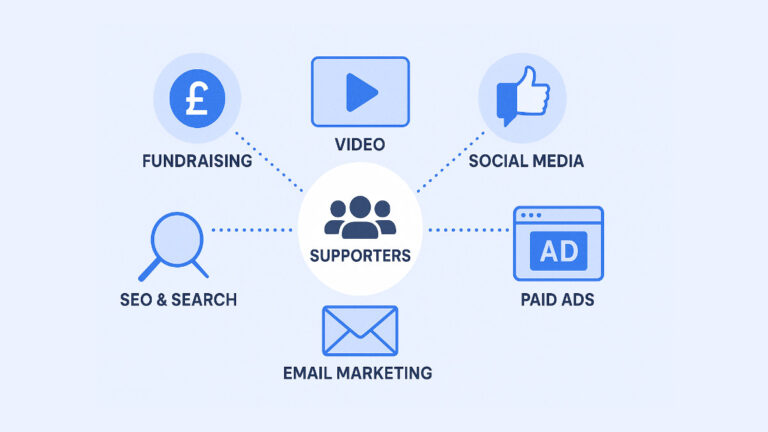



Email is the only channel where you own the relationship. Social platforms lend you an audience on terms they can change without warning; a mailing list stays yours.
That’s why it’s worth the effort even at small scale. A charity with 500 people it can reach directly is in a better position than one with 5,000 followers it can’t.
Three things decide whether it works: who you’re allowed to email, whether you have anything worth sending, and whether you can sustain it. Most small charities get stuck on the first and give up on the third.
If email is part of a wider question about reaching and keeping supporters, that sits in our marketing and fundraising support.
Who you are allowed to email
Two sets of rules apply here, and charities routinely reach for the wrong one.
UK GDPR governs the personal data – your lawful basis for holding it, your privacy notice, retention, and the rights people have. PECR, the Privacy and Electronic Communications Regulations, governs the sending. Whether you may put a marketing message in someone’s inbox is a PECR question, and an email policy built only around GDPR has skipped the part that decides whether you can press send.
There are now two routes.
Consent is the familiar one: the person actively agreed to receive marketing, usually by ticking an unticked box. It’s still available, and it’s the cleaner option if you want one list under one rule.
The charitable purpose soft opt-in came into force on 5 February 2026 and lets a charity email without prior consent where three conditions hold together. The sole purpose of the message is furthering the charity’s charitable purposes. The contact details were obtained when the person expressed interest in those purposes or offered support for them – a donation, an event booking, a volunteering enquiry. And a simple way to refuse marketing is given both when their details are collected and in every message afterwards.
One catch matters more than the rest: it isn’t retrospective. Addresses collected before February 2026 stay under the old consent rules. Most small charities therefore have two groups on one list, and no way to tell them apart unless their records show when each address arrived and what the person was doing at the time.
The provision also doesn’t stretch to messages with a commercial purpose – a trading subsidiary’s products, a partner’s offer. And it changes nothing under UK GDPR.
Not sure which of your supporters you can legally email?
Most small charity lists were assembled over years with no record of where each address came from, which is exactly the information the rules now turn on. A free Charity Consultation will help you work out what you’re holding.
Record where every address came from
Three pieces of information against every address: where it came from, when, and what the person was doing at the time.
That sounds like admin, and it’s now the thing that determines whether you may contact someone. A list of email addresses with no provenance is a list you can’t safely use.
Most addresses arrive through the same few doors – the donation page, an event booking, a newsletter form, a paper sheet at a community event. Each of those needs the opt-out or opt-in wording that matches the route you’re relying on, and most are inherited from a platform default rather than chosen. The donation page is where this gets settled most often.
What to send, and how often
Pick a frequency you can sustain rather than one you’ve read is optimal. Four thoughtful emails a year beat twelve nobody had time to write properly, and a list that hears from you twice then never again is worse than one that hears from you quarterly for a decade.
Write to one person rather than to a list. Send from a named human with a reply address that reaches them – replies are the most useful thing a small charity’s email programme produces, and an automated no-reply address throws them away.
Give people something other than an ask most of the time. A supporter who only hears from you when you need money learns not to open. What happened because of them, what you learned, what’s coming – these are worth sending, and they make the occasional ask land better.
Segment only when it earns its keep. On a list of a few hundred, splitting into six audiences creates work without insight. Two groups – people who’ve given and people who haven’t – is usually as far as it’s worth going until the numbers justify more.
What not to do
Don’t buy, rent or swap lists. Permission doesn’t transfer, and neither route above will cover you.
Don’t incentivise sign-ups with prize draws or giveaways. The source of an address determines whether you can use it, and a competition entrant hasn’t expressed interest in your charitable purposes.
Don’t bury the unsubscribe. Someone leaving is telling you something useful and protecting your sender reputation while they do it. A person who has to hunt for the link will report you as spam instead, which costs you far more.
And don’t email a long-dormant list to “get back in touch”. If nobody has heard from you in three years, the complaint rate will damage your deliverability for everyone else.
What to measure
Deliverability first. Bounce rates and spam complaints decide whether anything else matters, and an uncleaned list quietly stops arriving.
Open rates are less reliable than they were, because privacy features in some email apps register opens that didn’t happen. Treat them as a direction rather than a number.
Clicks, replies and unsubscribe rate tell you more. So does what happened afterwards – whether people gave, signed up, or turned up.
Before you send anything
Four checks. Your privacy notice describes what you actually do with the data. Your records show the source and date of every address. Unsubscribe requests get processed rather than collected. And one named person is responsible for the list, which belongs in your charity policies rather than in someone’s head.
Fundraising messages also have to meet the standards in the Code of Fundraising Practice, which sits alongside the legal position rather than inside it.
Email rewards charities that turn up consistently and say something worth reading. Neither of those requires a budget, which is why it’s the channel most worth building when you don’t have one – the wider argument sits in what to fix first in digital fundraising.
If the underlying problem is that nobody knows what’s in the list or where it came from, that is a defined piece of work – and a one-off project will sort it.