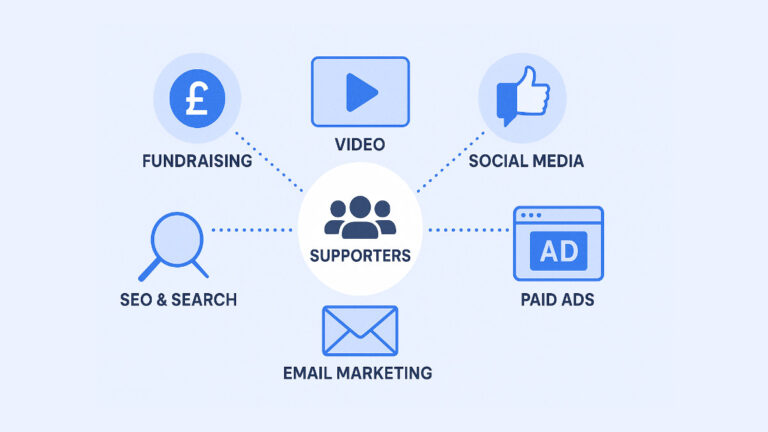



Digital marketing for a small charity is not a list of channels to be present on. It is a sequence, and the order matters more than the effort you put into any single part of it.
Most small charities start with social media, because it is visible, free at the point of use, and feels like progress. It is also the only part of the list you do not own, the hardest to measure, and the first thing to lapse when the person running it leaves. Starting there is why so much charity marketing produces activity and no result.
If your marketing is producing effort rather than enquiries, you can book a free clarity call.
The order most charities get wrong
Work through these in sequence. Each one is worth more once the previous is in place, and most small charities never need to reach the end.
Be findable and credible when somebody looks you up. Own a list you can reach without a platform’s permission. Decide what you publish and how often. Then, and only then, think about social media and paid advertising.
The reason for the order is compounding. A website that stands up and a list you own keep working while you are busy. Social media and advertising stop the moment you do.
First: be findable and credible
Before anyone donates, volunteers or funds you, they search your name. A grants officer assessing an application, a prospective trustee deciding whether to say yes, a referral partner checking you exist. What they find decides whether the conversation continues.
That makes your charity website the first priority. It needs to say clearly what you do, who for and where, show that you are currently active, carry your registered charity number, and work properly on a phone. A site that fails those tests undermines everything else you do.
Alongside it sits search visibility, which for a local charity is mostly a matter of being clear about what you do and where you do it, and being listed properly on Google Business Profile. It is less technical than it sounds, and it compounds quietly.
Second: own a list
An email list is the only audience you control. Social platforms decide who sees your posts and change that decision without telling you. A list you hold reaches everyone on it, every time.
For a small charity, this matters more than reach. Two hundred people who chose to hear from you are worth more than two thousand followers who scrolled past. They gave before, they attended something, they know who you are.
Building the list is a slower job than growing a following, and it needs consent recorded properly and somewhere to keep the records. Your supporter database is that somewhere, though a spreadsheet does the job for a long time.
Third: decide what you publish
Only now is it worth planning content, and the planning question is not what to write about. It is what the content is for, and how much you can sustain. The content strategy guide works through both.
The short version: pick one job for your content over the next six months, work out your real capacity and plan for eighty per cent of it, and accept that one decent piece a month sustained for two years beats a fortnight of daily posting followed by silence.
Charities usually arrive at marketing with the wrong question. Not “how do we reach more people” but “why is the effort we already put in producing nothing”. The answer is often that the sequence was never right, or that the charity is asking a crowded audience for something it has not yet given anyone a reason to say yes to. A free 30-minute clarity call is a reasonable place to work out which.
Social media: what it is for, and what it is not
Social media is good at reminding people who already know you that you exist, and at reaching the networks of people who already support you. It is poor at finding strangers who will give, and it does not build a relationship you own. The social media guide covers how small charities use it well.
Two practical rules. Pick one platform and do it properly rather than three badly, choosing the one your supporters actually use rather than the one that sounds current. And treat every post as a route back to something you own, whether that is your site or your list.
Where you are running more than one channel, the omnichannel guide covers keeping them consistent without doubling the work.
Paid advertising: when it is worth the effort
Registered charities can apply for Google Ad Grants, which provides up to $10,000 USD a month in free search advertising. In the UK, eligibility now runs through Google for Nonprofits with verification by Goodstack, which replaced TechSoup.
The figure is less generous than it sounds. Accounts have to hold a 5% click-through rate, run conversion tracking and avoid generic keywords, or the grant is suspended. Most accounts use a small fraction of the allowance because nobody manages them. It is free advertising that costs staff time, and it is worth applying for only if somebody will look after it.
Paid social is a different proposition. It can work for a specific campaign with a date and a budget, and it is a poor use of money as a background activity. If you cannot say what a click is worth to you, do not buy clicks.
What to skip
A small charity can safely ignore most of what the sector discusses.
Audience personas, in the full marketing sense, are over-engineered for an organisation with two part-time staff. You know who your supporters are. Write for them.
New platforms, until your existing ones are working. AI tools have real uses in drafting and repurposing, and none of them fixes having nothing to say.
And anything that produces content you cannot maintain. An abandoned channel is worse than one you never started, because it is visible evidence of something that ran out of steam.
How to tell it is working
Judge the sequence by outcomes rather than by activity.
The right people finding you, which usually shows up as somebody mentioning they looked at your site before getting in touch. The size and health of the list you own. Enquiries and conversations that went somewhere. And whether the effort is sustainable, because a programme nobody can maintain has already failed regardless of its numbers.
What to ignore: follower counts, impressions and reach. They move for reasons unconnected to anything you did, and they are the easiest numbers to report to a board that has not been told what to look at instead.
If you would rather work through the sequence with someone, our marketing and fundraising support covers the strategy and the infrastructure behind it.